Knee Pain in Northville, MI: Drug-Free Treatment at Get Well Chiropractic
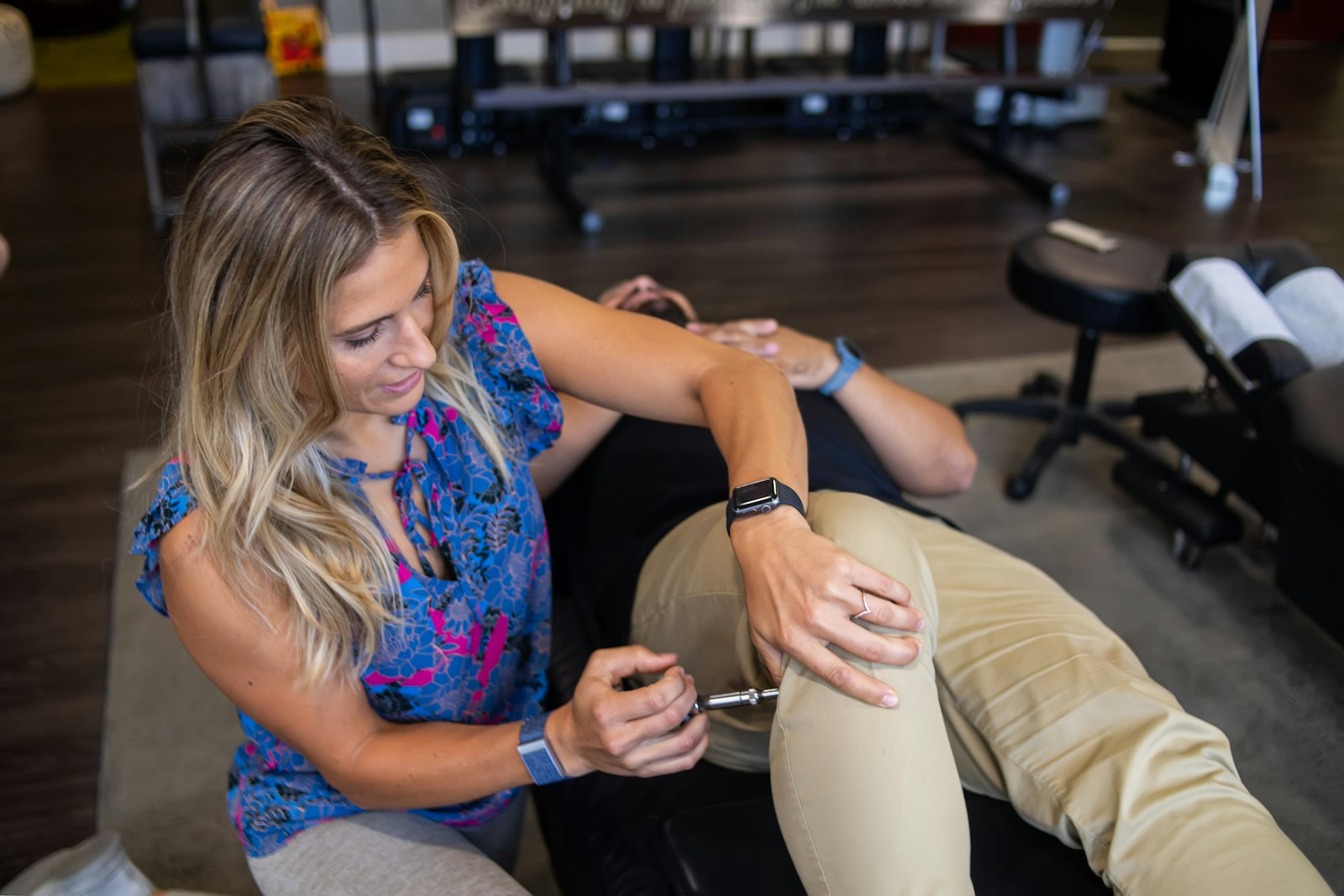
Knee pain is one of the most common complaints Dr. Stacie Ford sees in Northville — and one of the most undertreated, because patients often don't know that meaningful drug-free options exist between "ibuprofen and rest" and "talk to a surgeon."
If you've been waking up with a knee that stiffens overnight, or finding that stairs, kneeling, or long walks have become something you manage rather than enjoy, you are not alone. According to the Centers for Disease Control and Prevention, osteoarthritis affects an estimated 32.5 million U.S. adults, and the knee is the joint it most commonly affects. For many patients in the Northville–Novi–Plymouth corridor, knee pain starts as an inconvenience and slowly expands into a daily limitation — affecting how they walk, sleep, exercise, and work.
The good news: there is a well-supported, drug-free path to meaningful improvement that most patients never fully explore before being handed a surgery referral. At Get Well Chiropractic in Northville, Dr. Stacie Ford evaluates and treats knee pain as a whole-body mechanical problem — because that is what it almost always is.
Why Knee Pain Persists — and Why Treating Only the Knee Often Falls Short
The knee is one of the most mechanically loaded joints in the human body, but it does not operate in isolation. Its function is shaped directly by what happens above it (the hip and pelvis) and below it (the ankle and foot). When the hip abductors are weak or the pelvis sits uneven, the knee compensates — absorbing stress it was not designed to carry. When foot mechanics are poor, alignment problems travel upward into the knee joint. And when the lumbar spine is restricted or irritated, nerve signaling to the quadriceps and hamstrings can be compromised, altering the muscular support the knee needs to stay stable and pain-free.
This is why isolated knee treatments — cortisone injections, knee braces, or quad-strengthening in isolation — frequently provide only partial or temporary relief. They address the knee without addressing the kinetic chain feeding the problem. A thorough chiropractic evaluation of knee pain looks at the full chain: lumbar and sacroiliac joint function, hip mobility and strength, knee mechanics, and lower-leg alignment.
What the Research Shows About Manual Therapy and Knee Pain
The evidence for conservative manual care as a first-line approach for knee osteoarthritis is clear and growing. A randomized controlled trial published in the National Library of Medicine found that a short-term manual therapy knee protocol significantly reduced pain and improved self-reported knee function immediately after the treatment period. A separate 2019 trial published in PubMed found that osteopathic manipulative treatment significantly improved function and reduced pain in knee osteoarthritis, with clinically meaningful effect sizes compared to controls.
Dr. Joshua Cleland, PT, PhD — a Professor of Physical Therapy at the University of Hartford and one of the most widely published researchers in orthopedic manual therapy — has documented in peer-reviewed research that combining spinal and peripheral joint manipulation with targeted exercise produces outcomes that neither intervention achieves alone. "Manual therapy applied to the lumbar spine and hip in combination with knee mobilization changes the neuromuscular environment of the entire lower extremity," reflects findings from Dr. Cleland's body of work — an observation that explains why chiropractic care, which addresses the whole kinetic chain rather than the knee in isolation, often succeeds where targeted knee treatments have not.
Separately, analysis from clinical outcome data found that patients who initiated musculoskeletal care with a chiropractor had substantially lower downstream healthcare costs and 90% decreased odds of early opioid prescription compared to those who started with a medical provider. For patients managing knee pain in a healthcare environment that too quickly moves toward pharmacology or surgery, that is a significant finding.
MYACT Acoustic Wave Therapy for Knee Conditions
For knee pain driven by tendinopathy — the patellar tendon, the IT band, or the pes anserine tendons — MYACT (Myofascial Acoustic Compression Therapy) is one of the most targeted tools available at Get Well Chiropractic. MYACT delivers precise acoustic sound waves into the affected soft tissue, stimulating fibroblast activity, reducing calcific deposits, and triggering neovascularization — the formation of new blood vessels that bring nutrients to chronically injured tendons that have poor blood supply on their own.
Patients with chronic runner's knee, jumper's knee (patellar tendinopathy), or IT band syndrome who have not responded well to rest, stretching, or standard therapy often find meaningful relief with MYACT because it addresses tissue pathology directly. Sessions are brief — typically 10 to 15 minutes at the affected site — and most patients notice progressive improvement across a series of treatments rather than a single dramatic change.
Cold Laser and Massage: Supporting the Full Recovery Picture
Cold laser therapy plays a supporting role in knee pain care at Get Well Chiropractic, particularly when active inflammation is present — bursitis, an acutely irritated joint, or a recent flare of a chronic condition. Cold laser delivers focused light energy to damaged cells, accelerating the cellular repair process and reducing swelling at the tissue level without heat or discomfort. Sessions are painless and typically take five to ten minutes.
Therapeutic massage rounds out the approach by releasing the muscular restrictions that develop around a painful knee. The IT band, the TFL, the hip flexors, and the calf muscles all tighten protectively around a hurting knee — and that muscular guarding becomes a source of pain in its own right. Targeted massage on these structures restores circulation, releases the protective pattern, and prepares the joint for more effective chiropractic care. When sequenced correctly with the other modalities, the combined effect is greater than any one approach alone.
What Knee Pain Care Looks Like at Get Well Chiropractic
New patients presenting with knee pain begin with a full intake that covers the history and pattern of the pain, a postural and gait assessment, orthopedic knee testing, hip and lumbar evaluation, and range-of-motion measurement. Dr. Ford explains her findings clearly and builds a care plan that addresses the whole mechanical picture rather than just the symptomatic knee.
Most patients begin to notice meaningful change within the first two to four weeks of consistent care, depending on how long the problem has been present and what is driving it. Progress is tracked with objective measures — pain ratings, range of motion, and functional capacity — throughout the plan so that both patient and doctor can see what is working. The goal is not just reducing pain: it is restoring function to the point where the knee can tolerate normal daily activity without constant management.
If knee pain has been limiting your life in Northville — whether that is hiking, pickleball, yard work, or simply getting through a full day without aching — there is a real, drug-free path forward. Dr. Stacie Ford and the team at Get Well Chiropractic are accepting new patients and no referral is needed. Contact us or call (248) 465-0000 to schedule your first appointment.
Frequently Asked Questions
Can a chiropractor treat knee pain, or only back pain?
Chiropractors are trained in the evaluation and treatment of the entire musculoskeletal system, including the knee joint itself and the spinal and hip segments that drive knee mechanics. Many knee pain presentations have a lumbar, sacroiliac, or hip component that plays as significant a role as the knee structure itself. Dr. Ford's evaluation covers the whole kinetic chain — which is often why her approach produces results where isolated knee-focused treatments have not.
Is chiropractic care safe for knee osteoarthritis?
Yes, with appropriate examination. Conservative manual therapy — including joint mobilization and spinal manipulation — is well-documented as safe and effective for knee osteoarthritis. Dr. Ford adapts technique and force to each patient's findings and comfort level. Patients with recent surgeries or certain acute inflammatory conditions may need a modified approach, which she discusses at the initial evaluation.
How many treatments will it take to see results?
This depends on how long the problem has been present, what is driving it, and how your body responds to care. Many patients notice meaningful improvement in pain and range of motion within three to six appointments. Chronic knee pain that has built over years typically takes longer than a recent onset. Dr. Ford will give you an honest, realistic timeline based on her specific findings at your first visit.
Do I need X-rays or MRI before starting chiropractic care?
In most cases, no. A thorough clinical evaluation — history, orthopedic testing, range-of-motion assessment, and gait observation — gives Dr. Ford the information she needs to begin care safely. If your presentation suggests a structural issue that warrants imaging (fracture concern, significant instability, or other red flags), she will tell you clearly and can help coordinate that next step.
What if I've already tried cortisone injections or physical therapy?
Many patients arrive at Get Well Chiropractic after trying injections or standard physical therapy without lasting results. That history does not disqualify you — it often means the underlying mechanical contributors were never fully addressed. A cortisone injection can reduce inflammation in the short term but does not change how hip, pelvis, and foot mechanics are loading the knee. That is what a thorough chiropractic evaluation addresses directly.
The information provided in this article is intended for educational purposes only and does not constitute medical advice, diagnosis, or a treatment plan for any specific condition. Reading this content does not establish a doctor-patient relationship. Individual results vary, and all healthcare decisions should be made in consultation with a licensed healthcare provider. If you are experiencing severe or worsening symptoms, please seek appropriate medical attention promptly.