Understanding Active Release Therapy: A Modern Solution for Chronic Pain
Active release therapy is a specialized, hands-on treatment method that targets soft tissue problems in muscles, tendons, ligaments, fascia, and nerves. This patented technique combines precise pressure with specific patient movements to break down scar tissue and adhesions that cause pain, restricted motion, and muscle weakness.
Quick Overview: What You Need to Know About Active Release Therapy
| Aspect | Key Information |
|---|---|
| What it treats | Carpal tunnel syndrome, sciatica, plantar fasciitis, tennis elbow, back pain, headaches, sports injuries |
| How it works | Practitioner applies targeted tension while you actively move the affected area through specific patterns |
| Treatment length | Most conditions resolve in 4 or fewer sessions, typically 15 minutes each |
| Pain level | Some discomfort during treatment; temporary soreness afterward is normal |
| Results | 93% reduction in pain levels; 42,000+ soft tissue conditions resolved annually |
| Who performs it | Only ART-certified providers (chiropractors, physical therapists) trained in 500+ specific protocols |
If you've tried massage, stretching, or traditional physical therapy without lasting relief, you're not alone. Many people struggle with persistent muscle and joint pain that keeps coming back despite treatment.
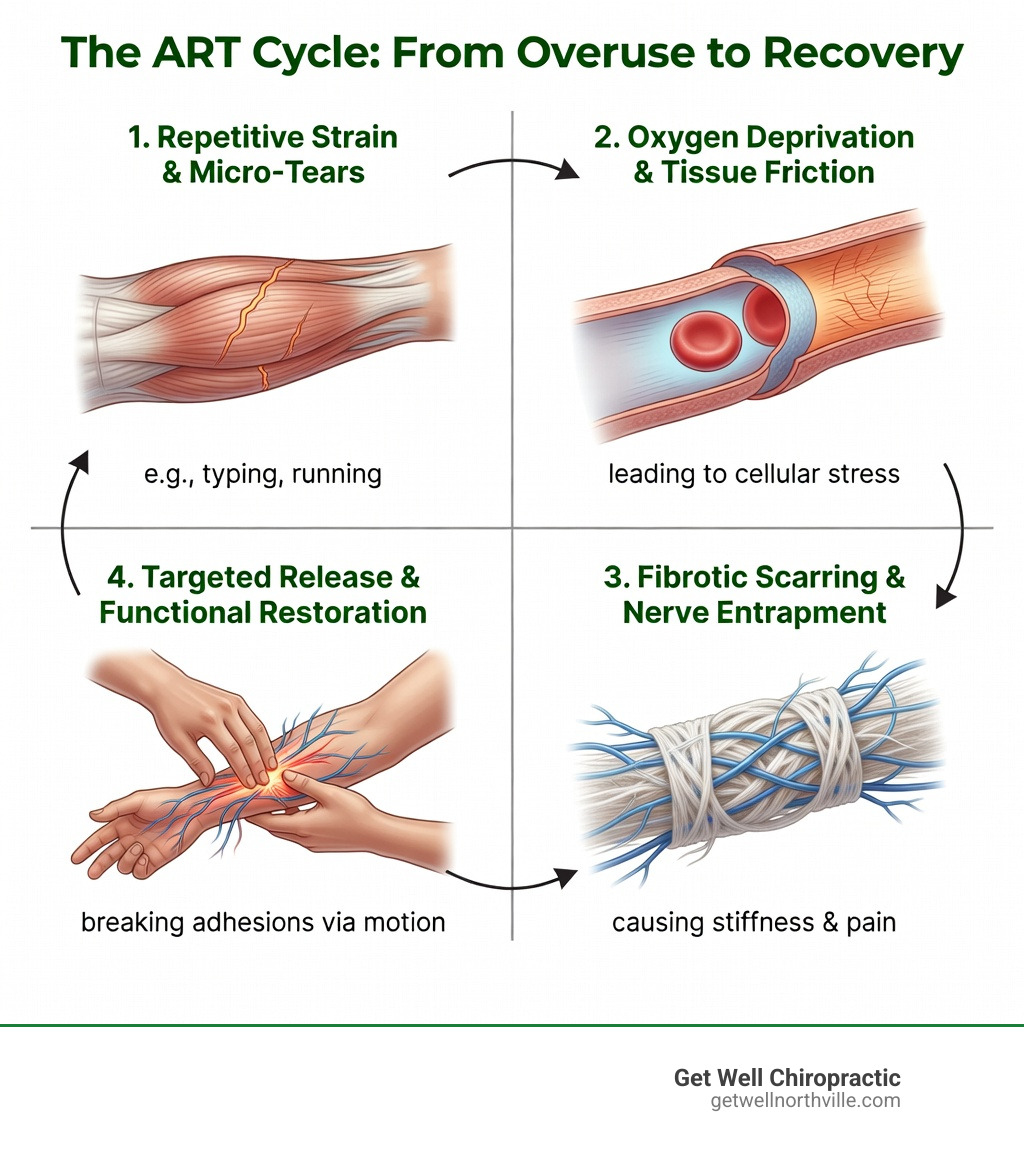
The problem often lies deeper than tight muscles. Repetitive motions, injuries, and overuse create scar tissue that binds soft tissues together. This restricts movement, traps nerves, reduces blood flow, and causes the chronic aching, numbness, or burning that won't go away.
Active Release Therapy takes a different approach. Instead of just treating symptoms, it addresses the root cause by systematically removing the adhesions that limit your body's natural healing. The technique was developed by Dr. P. Michael Leahy in 1985 and has since helped over 880,000 people annually regain their mobility and return to pain-free living.
Basic active release therapy vocab:
What is Active Release Therapy?
At its core, active release therapy is a movement-based massage system. But don't let the word "massage" fool you—this isn't a relaxing spa day. It is a highly technical, patented system designed to identify and treat over 450 specific structures within the musculoskeletal system.
When we use ART, we aren't just rubbing a sore muscle. We are looking for "adhesions." Think of adhesions like internal scar tissue that acts like glue, sticking your muscles, tendons, and nerves together. This often happens due to hypoxia (a lack of oxygen to the tissue) caused by repetitive strain or acute injury. When tissues don't get enough oxygen, they produce tough, dense scar tissue.

During a session, we perform a texture evaluation. We use our hands to feel the "glide" of your tissues. Healthy tissue should slide smoothly against other structures. If it feels snagged or crunchy, we know we’ve found the culprit. In addition to ART, we often find that myofascial acoustic compression therapy provides a fantastic technological complement for breaking down these stubborn restrictions.
The History and Development of Active Release Therapy
The story of ART begins in 1985 with Dr. P. Michael Leahy, a chiropractor who noticed that his patients' symptoms were often related to changes in soft tissue that could be felt by hand. He initially documented his work as a form of myofascial release, but as his methods became more refined and specialized, he developed the unique protocols that define ART today.
In 2001, the system was officially patented. What makes ART truly unique in healthcare is the rigor of its provider network. To become an ART Certified Provider, a practitioner must complete intensive 15-hour hands-on seminars and pass rigorous testing. Furthermore, because the technique is constantly evolving, we are required to undergo annual recertification to maintain our "Elite Provider" status. This ensures that when you visit us in Northville, you are receiving the most up-to-date care available.
How ART Works: The Technique and Process
The "Active" in active release therapy is there for a reason. Unlike traditional massage where you lie still, ART requires you to be a participant in your healing.
There are over 500 specific protocols in the ART system. Here is the general process:
- Identification: We use our hands to evaluate the texture, tightness, and movement of the muscle, fascia, tendon, or ligament.
- Tension: We apply precisely directed tension at the site of the adhesion.
- Movement: While we maintain that tension, you move the body part from a "shortened" position to a "lengthened" position.
This combination of manual tension and active movement "shears" the adhesions apart. It’s like pulling a piece of tape off a surface—by holding one end and pulling the other, the bond breaks. This process removes fibrosis and allows the tissue to glide freely again. If you are looking for other advanced ways to restore movement, you might also be interested in how MyACT therapy can help relieve pain and restore mobility.
ART vs. Traditional Massage
| Feature | Active Release Therapy (ART) | Traditional Massage |
|---|---|---|
| Patient Role | Active movement | Passive relaxation |
| Goal | Break adhesions & restore glide | Relaxation & circulation |
| Focus | 450+ specific structures | General muscle groups |
| Session Length | Short, targeted (15 mins) | Longer (30-90 mins) |
| Protocol | 500+ specific moves | Varied strokes (effleurage, etc.) |
Conditions Treated by Active Release Therapy
Because ART targets the fundamental building blocks of movement, it is effective for a staggering variety of conditions. Most of these are "overuse" injuries where the tissue has been stressed beyond its limit.
- Carpal Tunnel Syndrome: By releasing the entrapments around the median nerve in the wrist.
- Sciatica: Addressing the muscles in the hip (like the piriformis) that may be pinching the sciatic nerve.
- Plantar Fasciitis: Breaking up the thick adhesions in the bottom of the foot.
- Tennis and Golfer’s Elbow: Treating the tendons of the forearm that become scarred from repetitive gripping.
- Shin Splints: Releasing the tension between the calf muscles and the shin bone.
- Headaches: Often caused by "nerve entrapment" or adhesions in the small muscles at the base of the skull.
- IT Band Syndrome: Common in runners, this addresses the friction between the IT band and the knee/hip.
- Rotator Cuff Injuries: Restoring the complex sliding mechanics of the shoulder.
Benefits and Clinical Effectiveness
The numbers behind active release therapy are impressive, and they explain why it has become the "gold standard" for professional athletes and major corporations alike. Research and clinical data show a 93% reduction in pain levels among patients treated with ART. Nationally, it is estimated that ART improves over 880,000 lives every year.
One of the most interesting stamps of approval comes from the Occupational Safety and Health Administration (OSHA). Since 2006, OSHA has recognized ART as a "first aid" solution. This is a big deal for businesses. For example, in a case study involving Serta Simmons, the company realized an 89% decrease in Workers’ Comp costs after implementing an ART wellness program. Another group reported $535k in estimated savings on potential claims.
Why is it so effective? Because it works fast. Clinical overviews of ART highlight that while many therapies require dozens of sessions, ART has been proven to resolve many musculoskeletal conditions in four or fewer treatments.
Beyond just "fixing" injuries, we use ART for Performance Care. This is for the athlete who isn't necessarily "injured" but feels "tight" or "slow." By removing micro-adhesions before they become full-blown injuries, we can improve agility, power, and endurance.
What to Expect During Your Session
When you walk into our clinic in Northville, MI, your ART session will likely be shorter and more intense than a standard chiropractic visit.
- The Assessment: We start with a diagnostic touch. We'll ask you to move while we feel how the muscles respond.
- The Treatment: A typical session lasts about 15 minutes. During this time, we will work through the specific protocols for your injury.
- The Sensation: You will feel firm pressure. Most patients describe it as a "good hurt"—the kind of discomfort that feels like something productive is happening. If the sensation moves from discomfort to sharp pain, you simply let us know, and we adjust.
- The Frequency: Most people see significant results within 3 to 6 visits.
- The Homework: Once we release the adhesions, the work isn't over. We will often provide you with a customized plan that includes:
- Flexibility exercises to maintain the new range of motion.
- Strength restoration to support the joint.
- Proprioception drills to help your brain "re-map" how the muscle should move.
- Biomechanical analysis to ensure you aren't re-injuring yourself with poor posture or form.
Frequently Asked Questions about ART
Is Active Release Therapy painful?
This is the most common question we get! Because we are dealing with sensitive, scarred tissue, there is usually some level of discomfort. However, it should always be within your tolerance levels. We maintain constant communication with you throughout the process. Think of it like a very deep stretch. You might experience some temporary post-treatment soreness, similar to the feeling after a tough workout, but this usually fades within 24 to 48 hours.
How many sessions are typically needed?
One of the best things about active release therapy is its speed. While every body is different, the vast majority of our patients see a 95% resolution rate in five or fewer sessions. Acute injuries often respond even faster—sometimes in just one or two visits. Chronic conditions that have been present for years may take a few more sessions to fully "unstick" the layers of scar tissue.
Does insurance cover ART?
Many health insurance providers do reimburse for ART, often under the umbrella of physical therapy or chiropractic benefits. It is also widely covered by Workers' Compensation and motor vehicle accident claims. Because we are a certified provider, we can help you verify your benefits. We always recommend checking with your specific insurer to see if they cover "manual therapy" or "neuromuscular re-education," which are the technical terms often used for billing.
Conclusion
At Get Well Chiropractic in Northville, MI, we believe that you shouldn't have to "just live with" chronic pain. Whether you are a weekend warrior dealing with shin splints, an office worker struggling with carpal tunnel, or someone simply wanting to move more freely, active release therapy offers a path to natural healing without surgery or long-term medication use.
Our team is dedicated to providing honest, compassionate, and personalized care. We don't just want to fix your current pain; we want to partner with you for long-term wellness. If you’re ready to break the cycle of pain and scar tissue, we invite you to experience the ART difference.
Ready to get started? You can schedule a therapeutic massage in Northville or book a full ART evaluation with our team today. Let’s get you back to doing what you love, pain-free!
