Why Understanding a Herniated Disc Neck Matters for Your Recovery
Herniated disc neck pain affects between 0.5% to 2% of adults, most commonly between ages 30 and 50. If you're experiencing sharp pain radiating down your arm, numbness in your fingers, or weakness when lifting objects, you may be dealing with a cervical herniated disc.
Quick Answer: What You Need to Know
A herniated disc in the neck occurs when the soft, gel-like center of a spinal disc pushes through a tear in its tough outer layer. This can compress nearby nerves, causing:
- Sharp or burning pain in the shoulder, arm, or hand
- Numbness and tingling along specific nerve pathways
- Muscle weakness that affects grip strength or arm movement
- Neck stiffness that worsens with certain head positions
The good news? Approximately 75% of patients experience significant pain reduction within 6 weeks through conservative, non-surgical care. Most symptoms resolve completely within 4 to 6 months as the body naturally heals.
The cervical spine—your neck—contains seven vertebrae cushioned by intervertebral discs. These discs act as shock absorbers, with a tough outer shell (annulus fibrosus) protecting a soft, jelly-like center (nucleus pulposus). When the outer shell tears or weakens, the inner material can bulge or leak out, pressing on spinal nerves or the spinal cord itself.
Cervical herniated discs most commonly occur at the C5-C6 and C6-C7 levels, the most mobile segments of your neck. While this condition can cause intense discomfort, understanding what's happening in your spine is the first step toward effective, natural relief.
Whether your herniation resulted from age-related wear, a sudden injury, or repetitive strain, multiple non-invasive treatment options exist. Many people find significant relief through chiropractic care, spinal decompression therapy, and targeted exercises—without medications or surgery.
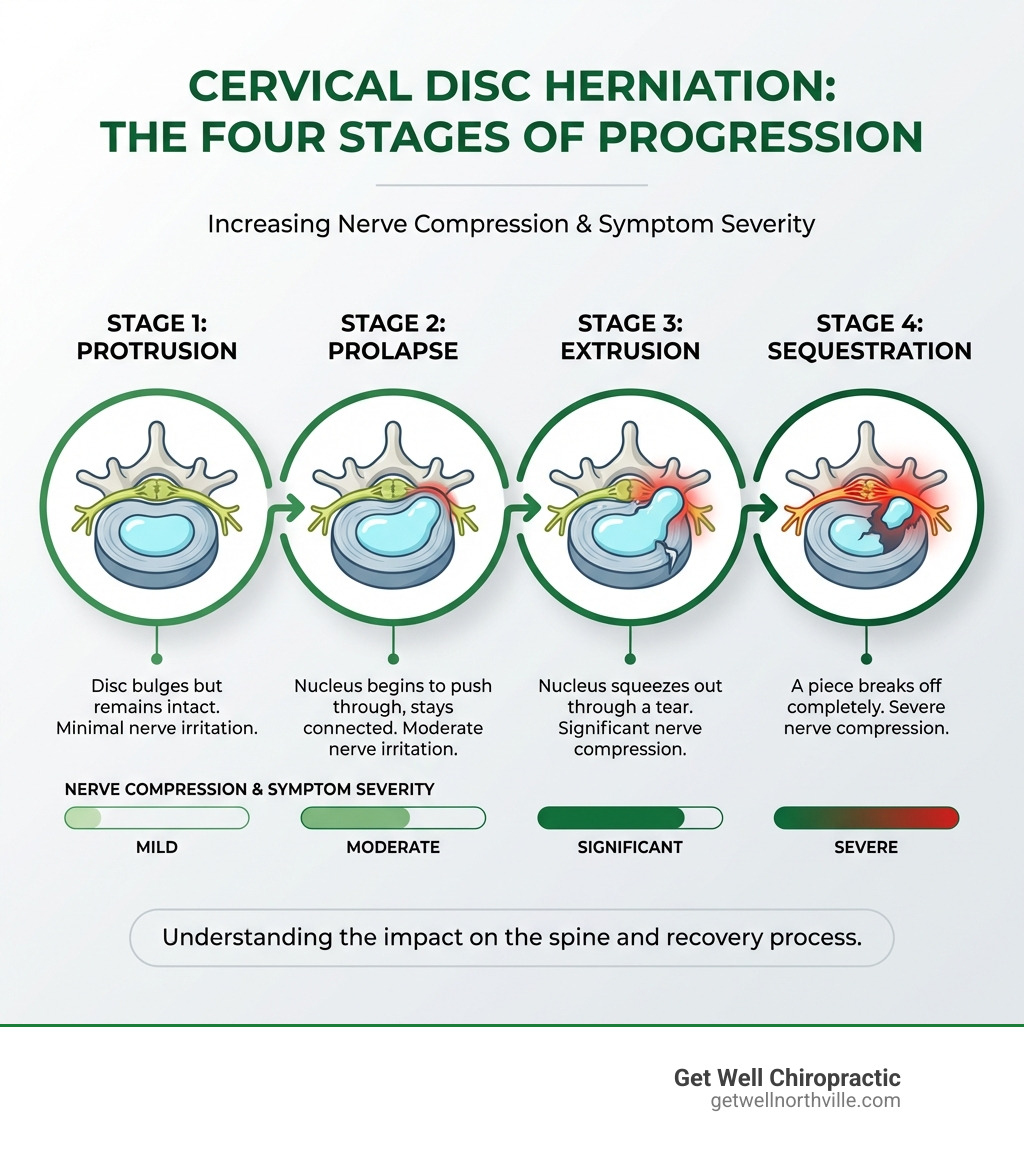
Understanding the Anatomy of a Cervical Herniated Disc
To understand why a Herniated disc neck feels the way it does, we have to look at the "shock absorbers" of your spine. Your cervical spine is made up of seven bones called vertebrae (C1 through C7). Between these bones are intervertebral discs. Think of these discs like a jelly donut: they have a tough, rubbery exterior called the annulus fibrosus and a soft, jelly-like center called the nucleus pulposus.
These discs are marvels of engineering. They allow your neck to move in almost every direction while protecting the spinal cord and the nerves that branch out to your arms. However, the cervical spine is also the most mobile part of your back, which makes it susceptible to wear and tear.
The most common sites for a Herniated disc neck are the C5-C6 and C6-C7 levels. This is because these segments handle the most movement and stress when you turn your head or look down at your phone. When a herniation occurs, the jelly-like nucleus pushes through a tear in the annulus.
According to Scientific research on Cervical Disc Herniation, the pain isn't just caused by the physical "pinch." When the inner disc material leaks out, it releases inflammatory cytokines—chemical messengers that irritate the nerve roots. This combination of mechanical pressure and chemical irritation leads to radiculopathy, which is the medical term for pain, numbness, or weakness that travels along a nerve pathway into your arm.
Common Triggers for a Herniated Disc Neck
While we often wish there was one specific moment we could point to, a Herniated disc neck is frequently the result of a "last straw" scenario. Here are the most common triggers we see in our Northville community:
- Age-related degeneration: As we age, our discs naturally lose water content (a process called desiccation). This makes them less flexible and more prone to cracking or tearing even with minor movements.
- Sudden trauma: Car accidents (like whiplash), falls, or sports injuries can put sudden, extreme force on the disc, causing an acute rupture.
- Repetitive strain: This is becoming increasingly common with "tech neck." Spending hours with your head tilted forward over a computer or smartphone puts immense pressure on the cervical discs.
- Genetic predisposition: Some of us simply inherit discs that are less resilient than others.
- Improper lifting: While we usually think of the lower back when lifting, using your neck or upper back to "heave" a heavy object can cause a cervical disc to fail.
Recognizing the Symptoms of a Herniated Disc Neck
The symptoms of a Herniated disc neck are rarely confined to just the neck. Because the nerves in your neck travel down your arms to your fingertips, a problem in the spine often "broadcasts" pain elsewhere.
Common symptoms include:
- Sharp, burning pain: This often feels like an electric shock that shoots from the neck into the shoulder and down the arm.
- Numbness and tingling: You might feel "pins and needles" in your thumb, index finger, or middle finger, depending on which nerve is compressed.
- Muscle weakness: You might notice you’re dropping things more often or that your grip isn't as strong as it used to be.
- Dermatomes: These are specific areas of skin assigned to specific nerves. For example, a C6 herniation often affects the thumb side of the hand, while C7 affects the middle finger.
During a consultation, we may use the Spurling test. This involves gently extending and rotating the head toward the painful side and applying slight pressure. If this reproduces your arm pain, it’s a strong indicator of nerve root compression. You can read more about how these symptoms manifest in this Cervical radiculopathy review.
Warning Signs of a Severe Herniated Disc Neck
In most cases, a herniated disc is a manageable condition that responds well to conservative care. However, if the disc material pushes directly backward into the spinal canal, it can compress the spinal cord itself—a condition called myelopathy.
Watch for these "red flag" symptoms:
- Coordination issues: Difficulty with fine motor skills, like buttoning a shirt or handwriting.
- Heavy legs: A feeling of weakness or "heaviness" in the lower body, or a change in the way you walk (gait).
- Bladder or bowel dysfunction: Any sudden loss of control is a medical emergency.
- Balance problems: Feeling unsteady on your feet or experiencing frequent trips or falls.
If you experience these symptoms, it is vital to seek an immediate evaluation.
Diagnosis and Non-Surgical Treatment Pathways
When you visit us at Get Well Chiropractic, our first goal is to determine exactly which disc is involved and how much the nerve is being affected. This starts with a thorough physical examination and neurological testing—checking your reflexes, muscle strength, and sensation.
While a physical exam tells us a lot, imaging helps confirm the diagnosis. The MRI is the gold standard for a Herniated disc neck because it provides a clear view of soft tissues like discs and nerves, which don't show up on standard X-rays.
The good news for our Northville neighbors is that surgery is rarely the first answer. Research shows that 75% to 90% of acute cervical radiculopathy cases improve with conservative management.
| Treatment Type | Primary Goal | Benefit |
|---|---|---|
| Chiropractic Care | Restore alignment and joint function | Reduces mechanical stress on the disc |
| Spinal Decompression | Create negative pressure within the disc | Encourages the herniation to retract |
| Physical Therapy | Strengthen supporting muscles | Improves posture and long-term stability |
| Activity Modification | Reduce irritation | Prevents further "leaking" of disc material |
At Get Well Chiropractic, we focus on Chiropractic Care that addresses the root cause. By improving the alignment of the vertebrae, we can take the "pinch" off the nerve and allow the body's natural healing processes to take over. We may also suggest lifestyle changes and ergonomics to ensure the problem doesn't return.
Non-Invasive Relief for a Herniated Disc Neck
One of the most effective tools we use for a Herniated disc neck is Spinal Decompression Therapy. Unlike traditional traction, which simply pulls the spine, computer-controlled decompression uses a specific cycle of stretching and relaxing.
This process creates negative pressure (a vacuum effect) inside the disc. This does two wonderful things:
- It helps the bulging or "leaked" disc material retract back toward the center of the disc, away from the nerve.
- It creates a "pump" that draws in a nutrient-influx of oxygen, water, and healing fluids that the disc needs to repair itself.
You can explore more about these techniques in our guide on Key Insights into Neck Decompression Therapy Methods. When combined with therapeutic exercises to stabilize the neck, this approach offers a powerful alternative for those wondering Why Choose Chiropractic Care for Pain Relief.
When Advanced Care May Be Necessary
While we are passionate about natural healing, we are also committed to your safety and long-term health. Most patients see significant improvement within a 6-12 week window of conservative care. However, if you experience intractable pain that doesn't respond to treatment, or if your neurological symptoms (like weakness) are getting worse, it may be time for advanced care.
In these instances, we will refer you to an appropriate medical specialist, such as a physiatrist or a spine surgeon, for further evaluation. They may discuss options like epidural steroid injections to manage severe inflammation or, in rare cases, surgical procedures to remove the disc material. Even if advanced medical intervention is required, the rehabilitation and follow-up care provided by your chiropractor is essential for maintaining the health of the rest of your spine and preventing future issues.
Frequently Asked Questions about Cervical Discs
Can a herniated disc in the neck heal on its own?
Yes! The body has an amazing ability to heal through a process called natural resorption. When the inner "jelly" leaks out, the body recognizes it as something that shouldn't be there and sends specialized cells to break it down. Over time, the disc material may also undergo desiccation (drying out), which causes it to shrink away from the nerve. Statistics show that about 75% of people see significant improvement within 6 weeks without invasive intervention.
What activities should I avoid with a neck herniation?
During the acute phase of a Herniated disc neck, you should avoid:
- Heavy lifting: Anything over 5-10 lbs can increase pressure in the disc.
- High-impact sports: Running or jumping can cause "jarring" of the cervical spine.
- Prolonged neck flexion: Avoid looking down at your phone or tablet for long periods (the "tech neck" position).
- Contact sports: Any activity with a risk of sudden head movements or collisions should be paused.
How do I know if my neck pain is a herniated disc or a muscle strain?
Muscle strains are usually confined to the neck and upper shoulders; the pain is often dull and achy, and it typically improves within a few days of rest. A Herniated disc neck usually involves radiating symptoms—pain, numbness, or tingling that travels down the arm. If your pain is accompanied by weakness or lasts longer than a week, it’s likely more than just a simple strain.
Conclusion
A Herniated disc neck can be a frightening and painful experience, but it doesn't have to mean the end of your active lifestyle. At Get Well Chiropractic in Northville, MI, we believe in a personalized wellness approach that honors your body's ability to heal. From gentle chiropractic adjustments to advanced spinal decompression, our goal is to provide honest, compassionate care that leads to long-term spinal health.
If you're tired of "just living with the ache," we're here to help you move beyond it. Our team is dedicated to natural healing and helping you achieve the quality of life you deserve.
Ready to find relief? Start your recovery with Spinal Decompression Therapy and take the first step toward a healthier, pain-free neck today.
