Why Shoulder Trigger Points Demand Your Attention
Trigger point pressure release shoulder techniques can provide immediate relief from that deep, stubborn ache that won’t quit. If you’re dealing with shoulder pain right now, here’s what you need to know:
Quick Release Method:
- Locate the tender spot – Press gently on your shoulder muscle until you find a tight, painful knot
- Apply steady pressure – Use your fingers, a massage ball, or tool to press into the point for 30-60 seconds
- Breathe deeply – As you hold pressure, the pain should gradually decrease
- Stretch gently – After releasing, move your shoulder through its normal range of motion
Most Common Shoulder Trigger Point Locations:
- Upper trapezius (top of shoulder) – causes neck pain and headaches
- Infraspinatus (shoulder blade) – creates deep ache in front of shoulder
- Lower trapezius (mid-back) – produces heavy sensation at shoulder joint
Have you ever experienced that nagging ache under or around your shoulder blade that just won’t go away? Maybe it’s the kind of pain that worsens when you reach overhead or turn your head. You’re not alone.
Trigger points are tender knots in your muscles that refer pain to other areas. They’re incredibly common – research shows nearly 60 out of 72 people examined had trigger points in their infraspinatus muscle alone.
These aren’t just ordinary muscle knots. Trigger points are areas where muscle fibers have gone into spasm, restricting blood flow and causing a buildup of waste products. This creates a painful cycle: spasm leads to restricted blood flow, which causes more spasm.
There are two types you should know about:
- Active trigger points cause constant pain and limit your movement
- Latent trigger points don’t hurt until pressed, but still weaken muscles and restrict motion
The good news? You can learn to release these points yourself. With the right techniques, many people experience significant relief within just a few sessions.
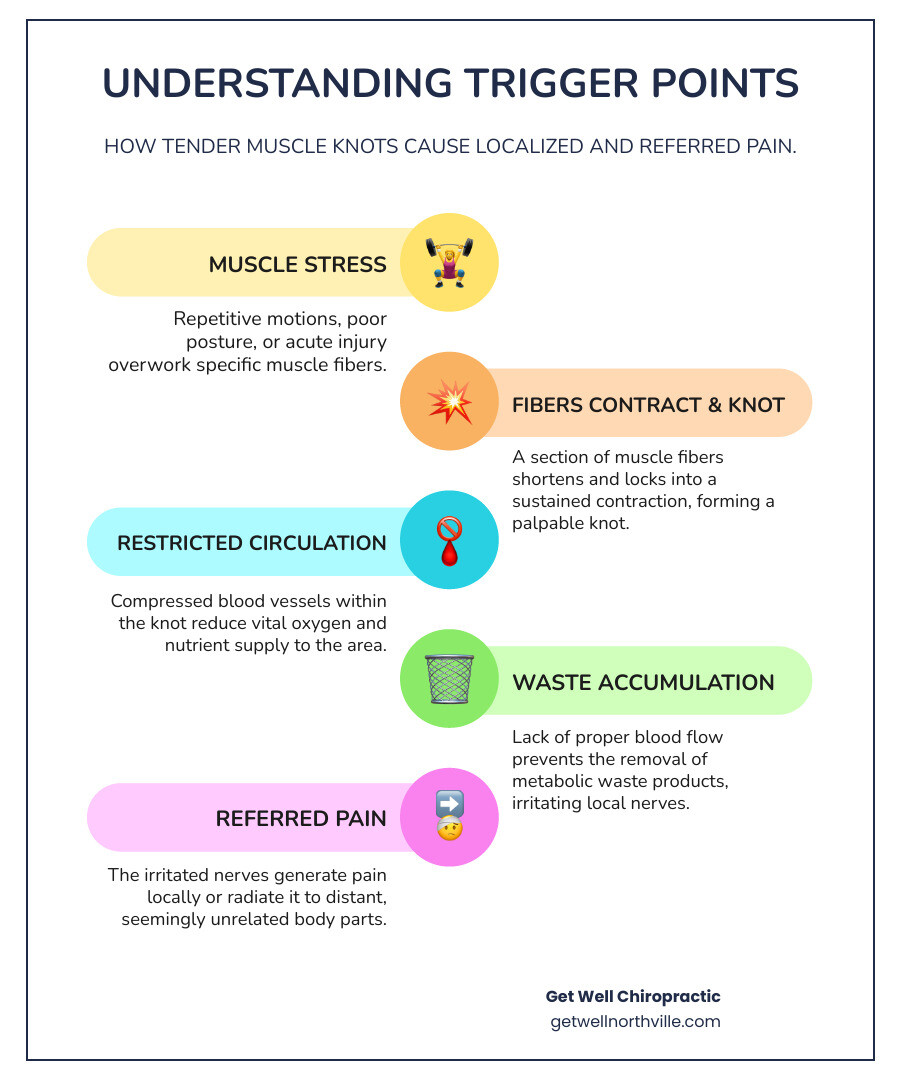
The Culprits Behind the Knots: Common Causes and Key Muscles
We’ve all been there – that unexpected muscle knot that zings to life, often in our neck or shoulders, after a long day. But what exactly causes these stubborn trigger points to form in the first place? It’s often a combination of everyday habits and external factors that lead our muscles to protest.
One of the biggest culprits is poor posture. In our modern, tech-driven world, many of us spend hours hunched over phones or leaning forward at computers. This constant strain on our neck and shoulder muscles creates micro-tears, restricts blood flow, and sets the stage for trigger point formation. For instance, a mere 15-degree forward head tilt can add up to 27 pounds of strain on the neck muscles. Imagine what that does to your shoulders over time! We believe that addressing your posture is a crucial step toward long-term wellness. More info about posture benefits and overall musculoskeletal health can be found on our website.
Beyond posture, repetitive movements are another common cause. Whether it’s from sports, work, or even daily habits, performing the same motions over and over without proper rest or counter-stretching can fatigue muscles and lead to knots. Think about painting, typing, or even rowing – all can contribute to trigger points.
Stress, both emotional and physical, also plays a significant role. When we’re stressed, our bodies instinctively tense up, often causing our shoulders to rise and our muscles to guard. This unconscious, chronic muscle tension restricts blood flow and can lead to the development of painful trigger points. Accidents like whiplash injuries or falls, and even our sleeping positions, can also contribute to these muscle woes. Furthermore, prolonged constricting pressure on muscles, such as from a heavy backpack with thin straps or overly tight clothing, can cut off circulation and cause trigger points to emerge.
Key Muscles and Their Pain Patterns
Understanding which muscles are involved and where their pain refers is like having a secret map to your discomfort. Here’s a look at some of the most common shoulder and upper back muscles where trigger points hide, along with their tell-tale pain patterns:
| Muscle Group | Primary Location | Common Trigger Point Location(s) | Typical Referred Pain Pattern |
|---|---|---|---|
| Trapezius | Neck, upper back, shoulders | Upper: Top of shoulder, base of neck; Lower: Mid-back, near spine | Upper: Neck stiffness, headaches (temple, behind ear, back of head), shoulder joint pain; Lower: Pain/tenderness, ‘heavy’ sensation at top of shoulder joint |
| Infraspinatus | Under the shoulder blade | Along the inner border of the shoulder blade, or posterior shoulder | Deep ache in the front of the shoulder, radiating down the arm, sometimes mimicking bicep tendon or shoulder joint issues |
| Teres Major | Lower part of shoulder blade, near armpit | Near the armpit, lower shoulder blade | Often deep, aching pain in the shoulder joint, sometimes radiating down the back of the arm |
| Levator Scapulae | Side of neck, attaches to top of shoulder blade | Top corner of shoulder blade, side of neck | Pain traveling up the neck, settling into the inner upper corner of the scapula, sometimes causing neck stiffness and limited rotation |
| Rhomboids | Between the shoulder blades | Between the spine and inner border of the shoulder blade | Burning sensation, stiffness, or a deep ache between the shoulder blades, often worse with prolonged sitting or poor posture |
Why You Shouldn’t Ignore Shoulder Trigger Points
Ignoring those nagging knots isn’t just about tolerating discomfort – it can lead to a cascade of problems for your body. Trigger points are sneaky culprits; if left unaddressed, they can significantly impact your overall well-being.
Firstly, they cause muscle weakness and limited range of motion. When a muscle is locked in a tight, spasmed state, it cannot function optimally. This can make everyday tasks, from reaching for a high shelf to putting on a coat, surprisingly difficult. Trying to strengthen a muscle with an active trigger point before inactivating it can actually put more strain on the muscle, worsening the problem.
Secondly, untreated trigger points can perpetuate a chronic pain cycle. What starts as an intermittent ache can become a constant companion, affecting your sleep, mood, and concentration. This persistent pain can even lead to changes in your central nervous system, making you more sensitive to pain overall. When pain becomes chronic, it can be much harder to treat, becoming a long-term consequence of ignored muscle issues. For more insights into the long-term consequences of untreated myofascial trigger points, you can review relevant research on the topic: Long-term consequences of untreated MTrPs.
Finally, these silent sufferers can cause headaches, particularly tension headaches, often referred from trigger points in the upper trapezius. They can also lead to abnormal mechanics of the shoulder joint, contributing to other shoulder problems. Addressing trigger points early is vital for preventing these issues from escalating. Luckily, massage therapy is a powerful tool in alleviating this pain and restoring function. Find out more about How massage therapy alleviates pain.
The Power of Trigger Point Pressure Release for Shoulder Relief
When you’re dealing with stubborn shoulder pain, the thought of finding relief can feel like a distant dream. But we’ve seen the transformative power of trigger point pressure release shoulder therapy. This targeted approach isn’t just about temporary fixes; it’s about addressing the root cause of your discomfort and helping your body heal.
The benefits of trigger point therapy for shoulder pain are extensive and, frankly, quite impressive. Our patients often report significant pain reduction, a dramatic improvement in their shoulder function, and increased mobility. Imagine being able to reach overhead without wincing, sleep through the night without throbbing pain, or simply move your arm freely again. This is the kind of relief we aim for.
Trigger point therapy works by breaking the pain cycle we discussed earlier. By applying precise pressure, we temporarily restrict blood flow to the knotted muscle fibers. When that pressure is released, a rush of fresh, oxygen-rich blood floods the area. This helps to flush out accumulated waste products, rehydrate the muscle, and encourage it to return to its healthy, relaxed state. This process is often referred to as ischemic compression, and it’s incredibly effective.
Clinical trials have demonstrated these benefits. In one study, a comprehensive trigger point treatment program showed significant improvement in shoulder function, with a mean difference of 7.7 on the DASH (Disabilities of the Arm, Shoulder and Hand) questionnaire after just 12 weeks. Even more encouraging, 55% of patients in the intervention group reported noticeable improvement, compared to only 14% in the control group. These aren’t just numbers; these are real people finding real relief.
How Is Trigger Point Therapy Different from a General Massage?
You might be thinking, “Isn’t this just a regular massage?” And while both aim to relax muscles and reduce tension, trigger point therapy takes a much more focused and clinical approach. Think of it this way: a general massage is like watering your entire garden, while trigger point therapy is like carefully pruning a specific, overgrown bush.
The key difference lies in the targeted pressure and intent. A general massage, like a Swedish massage, typically involves broad strokes and kneading across larger muscle groups to promote overall relaxation and circulation. It’s wonderful for stress relief and general muscle soreness.
Trigger point therapy, however, employs myofascial release techniques that hone in on those stiff, localized muscle cramps – the trigger points – within the fascial tissue. Fascia, by the way, is like a fibrous net that connects and wraps around all your muscles and body structures. When trigger points form in this tissue, they can be incredibly stubborn.
During a trigger point session, the practitioner actively searches for these specific knots. Once located, sustained, direct pressure is applied. This pressure is often described as feeling “good-bad” – it might be intense and even reproduce your familiar pain, but it’s a sign that we’re hitting the right spot. The goal isn’t just general relaxation; it’s to deactivate that specific knot, release the tension, and restore normal muscle function. It’s a conversation between you and the therapist, guiding them to the source of your pain.
This precise, clinical approach is why trigger point therapy is uniquely effective for specific, persistent pain like chronic shoulder discomfort. It’s about getting to the root of the problem, not just skimming the surface. To learn more about how different techniques can bring you relief, explore our guide to Discover Effective Massage Techniques for Pain Relief Today. You can also explore the Deep Tissue Massage vs. Regular Massage: Key Differences to understand more about specific massage approaches.
Your Guide to At-Home Trigger Point Pressure Release Shoulder Techniques
The great news is that you don’t always need a professional to begin finding relief. Many trigger point pressure release shoulder techniques can be safely and effectively performed right in the comfort of your home. With a few simple tools and a bit of practice, you can empower yourself to manage those stubborn knots.

Before you dive in, let’s cover some crucial safety precautions:
- Listen to your body: We can’t stress this enough. The pressure should be firm and therapeutic, but never excruciating. If you feel a sharp pinch, tingling, or increased pain, ease up or stop immediately.
- Pressure scale (1-10): Aim for a pressure level of 6-7 out of 10. You should feel discomfort, but it should be tolerable and ideally start to dissipate after 15-20 seconds.
- Breathing techniques: Deep, slow breathing is your best friend. It helps relax your muscles and allows the pressure to penetrate more effectively.
- Duration of pressure: For most self-release techniques, apply steady pressure for 30-60 seconds per point. The idea is to allow the muscle to “let go,” which takes a little time.
- Avoid sensitive areas: Never apply direct pressure to bones, joints, or directly on your spine. Stick to muscle tissue only. If you have acute inflammation, blood clotting disorders, recent fractures, surgeries, or severe osteoporosis, consult a healthcare professional before attempting self-release.
Step-by-Step Trigger Point Pressure Release for the Shoulder: Trapezius
The trapezius, often called the “stress muscle,” is a prime location for trigger points, especially the upper and lower sections. Releasing these can significantly alleviate neck pain and headaches.

-
Upper Trapezius (Top of Shoulder):
- Finding the spot: Gently pinch the muscle at the very top of your shoulder with your opposite hand. Roll your fingers around until you find a tender, ropey band or a distinct knot.
- Using your fingers/thumb: Once you’ve located a trigger point, apply steady pressure with your thumb or fingers. Hold for 30-60 seconds, breathing deeply. You might feel the pain lessen or “melt” under your touch.
- Using a self-massage tool (like a hook-shaped cane): For hard-to-reach spots or for better leverage, use a self-massage tool. Place the hook over the upper trapezius, apply light to moderate pressure, and hold for 8-60 seconds. You can gently tilt your head slightly away from the tool to increase the stretch on the muscle.
- Wall technique: Place a tennis or lacrosse ball between your upper trapezius and a wall. Lean into the ball, adjusting your body to find the tender spots. Roll gently or hold static pressure for 30-60 seconds.
- Neck pain referral & headache connection: Trigger points here commonly refer pain to the back and side of your neck, your temples, behind your ear, and the back of your head. Releasing these points can often dramatically reduce these associated symptoms.
-
Lower Trapezius (Mid-Back):
- This area is particularly important for shoulder pain disorders. Trigger points here can cause a deep, “heavy” sensation at the top of the shoulder joint.
- Wall/Floor technique: Lie on your back on the floor or lean against a wall. Place a tennis or lacrosse ball just inside your shoulder blade, targeting the area of the lower trapezius. Adjust your body weight to apply moderate pressure. Hold for 30-60 seconds on any tender spots.
Advanced Trigger Point Pressure Release for the Shoulder: Infraspinatus
The infraspinatus is a critical part of your rotator cuff, and trigger points here are incredibly common, often causing a deep ache in the front of your shoulder.
- Finding the spot: The infraspinatus lies directly under your shoulder blade. It can be tricky to reach, but it’s worth the effort.
- Floor/Wall technique:
- On the floor: Lie on your affected side, propping your upper body with your elbow or hand. Place a tennis or lacrosse ball directly under your shoulder blade, targeting the infraspinatus. You might need to roll slightly forward or back to find the most tender spot. Once found, relax your body weight onto the ball and hold for up to one minute, breathing deeply.
- Against a wall: Place the ball between your infraspinatus and a wall. Lean into it, using your body weight to control the pressure. You can move your arm gently to help the ball sink into the muscle.
- Why it’s important: As we mentioned, nearly 60 out of 72 people examined had trigger points in their Infraspinatus muscle, highlighting its significant role in shoulder pain. Releasing this muscle can dramatically improve shoulder mobility and reduce that deep, nagging ache that often refers to the front of your shoulder. For athletes, maintaining healthy rotator cuff muscles is essential, and deep tissue massage techniques, including trigger point release, are vital for muscle recovery and performance. Check out Why Deep Tissue Massage is Essential for Athletes for more information.
Releasing Other Key Shoulder Muscles
While the trapezius and infraspinatus are common culprits, other shoulder muscles can also develop trigger points that benefit from targeted release.
-
Teres Major (Armpit Area): This muscle is located near your armpit and can contribute to shoulder pain and restricted movement.
- Technique: Lie on your affected side with your arm raised above your head. Place a tennis or lacrosse ball in your armpit, allowing your body weight to sink into the ball. Hold for up to one minute.
-
Levator Scapulae (Side of Neck): Trigger points here can cause pain that travels up your neck or settles into the upper inner corner of your shoulder blade.
- Technique: Use your fingers or thumb to gently palpate the side of your neck, just above your shoulder blade, until you find a tender spot. Apply moderate pressure and hold for 30-60 seconds. You can also gently tilt your head to the opposite side to increase the stretch.
-
Rhomboids (Between Shoulder Blades): These muscles are often tight in those with poor posture or who spend a lot of time at a desk, causing burning or stiffness between the shoulder blades.
- Technique: Lie on your back on the floor or lean against a wall. Place a tennis or lacrosse ball between your spine and your shoulder blade. Roll gently to find tender spots, then hold sustained pressure for 30-60 seconds.
Consistency is key. Performing these self-release techniques regularly can help prevent trigger points from becoming chronic and keep your shoulders feeling much happier.
Prevention and Professional Care: A Long-Term Strategy
While self-release techniques are incredibly empowering, a truly effective approach to managing and preventing shoulder trigger points involves a holistic long-term strategy. This includes making smart lifestyle choices and knowing when to seek professional help.
Ergonomic adjustments are non-negotiable, especially in our tech-heavy world. Your workstation setup can be a major source of strain. We recommend:
- Screen at eye level: This prevents constant looking down, which can add significant strain to your neck and upper back.
- Supportive chair: A chair with good lumbar support helps maintain the natural curve of your spine.
- Feet flat on the floor: Or supported by a footrest, to ensure proper alignment.
- Shoulders relaxed: Avoid shrugging your shoulders up towards your ears.
- Micro-breaks: Take short breaks every 30 minutes to stand, stretch, and move around.
Beyond the desk, proper lifting mechanics are crucial. Always lift with your legs, not your back, and keep objects close to your body. Avoid prolonged constricting pressure on your muscles, like from heavy bags. Integrating these simple changes can significantly reduce the likelihood of trigger point formation and improve your pain recovery. Learn more about How Deep Tissue Massage Benefits Enhance Pain Recovery.
Regular stretching routines and mobility exercises are also essential. Incorporate daily movements like neck rolls, shoulder shrugs, chest openers, and upper back stretches. After a self-release session, gentle stretches help lengthen the muscle and prevent it from tightening up again. Holding stretches for 3-5 minutes, rather than quick 10-15 second stretches, can be particularly beneficial for muscle relaxation and flexibility.
Finally, don’t underestimate the power of stress management. Chronic emotional stress often translates into physical tension, particularly in the shoulders. Techniques like deep breathing, meditation, or even just taking time for hobbies can help keep your muscles from constantly guarding.
When to See a Professional
While self-care is powerful, there are times when professional intervention is necessary. We encourage you to seek expert help if:
- Persistent pain: Your shoulder pain continues despite consistent self-release efforts for more than a few days or weeks.
- Numbness or tingling: You experience numbness, tingling, or weakness radiating into your arm or hand. This could indicate nerve involvement that requires professional assessment.
- Weakness that doesn’t improve: If you notice a significant decrease in strength that doesn’t resolve.
- After an injury: If your pain started after a fall, accident, or trauma.
- Sharp pain during self-massage: If applying pressure causes a sharp, intolerable pain rather than a “good-bad” sensation.
A healthcare provider can offer a precise diagnosis and develop a custom treatment plan. You can read more about What to expect from professional treatment from experts in the field. Integrating chiropractic care into your routine provides a broader perspective on musculoskeletal health, helping you achieve balance and prevent recurrence.
What to Expect from Professional Treatment
When you visit us at Get Well Chiropractic in Northville, MI, for shoulder pain, you can expect a comprehensive and personalized approach focused on your natural healing and long-term wellness.
- Comprehensive Assessment: We’ll start with a thorough evaluation to understand your specific pain patterns, medical history, and lifestyle factors. This helps us identify the exact trigger points and underlying causes of your shoulder discomfort.
- Manual Therapy: Our expert team uses various manual therapy techniques custom to your needs. This often includes targeted massage, such as deep tissue massage, to release stubborn trigger points. We also use gentle chiropractic adjustments to ensure your spine and joints are properly aligned, which is crucial for alleviating nerve pressure and promoting overall musculoskeletal health. Our Therapeutic Massage services are specifically designed to address these deep-seated issues.
- Personalized Exercise Plan: We don’t just treat the symptoms; we empower you with tools for lasting relief. You’ll receive a customized rehabilitation exercise plan to strengthen weakened muscles, improve flexibility, and correct any postural imbalances. This plan is designed to support the manual therapy and help prevent future trigger points from forming.
- Ergonomic & Lifestyle Advice: We’ll provide practical advice on ergonomic adjustments for your workspace and daily routines, along with guidance on stress management and proper body mechanics to support your recovery and prevent recurrence.
Our goal is to offer comfortable, honest, and compassionate service that gets you back to feeling your best.
Conclusion: Take Control of Your Shoulder Health
Living with shoulder pain caused by trigger points can be incredibly frustrating, limiting your movement and impacting your daily life. But as we’ve explored, understanding what trigger points are, what causes them, and how to effectively release them is the first step towards lasting relief.
By incorporating regular trigger point pressure release shoulder techniques into your routine – whether through self-massage tools, targeted stretches, or mindful ergonomic adjustments – you are actively taking control of your shoulder health. The benefits are clear: reduced pain, improved mobility, better posture, fewer headaches, and an overall improved quality of life. Consistency is your greatest ally in this journey.
However, you don’t have to go it alone. If your pain is persistent, severe, or accompanied by concerning symptoms like numbness or weakness, professional guidance is invaluable. At Get Well Chiropractic in Northville, MI, we combine expert therapeutic massage with precise chiropractic care to address both the symptoms and the underlying causes of your shoulder discomfort. Our compassionate approach focuses on natural healing and long-term wellness, empowering you to move freely and live without pain.
Don’t let those knots dictate your comfort. Take action today, accept the power of release, and reclaim your shoulder health. To find expert therapeutic massage for your shoulder pain, visit our Therapeutic Massage section.
